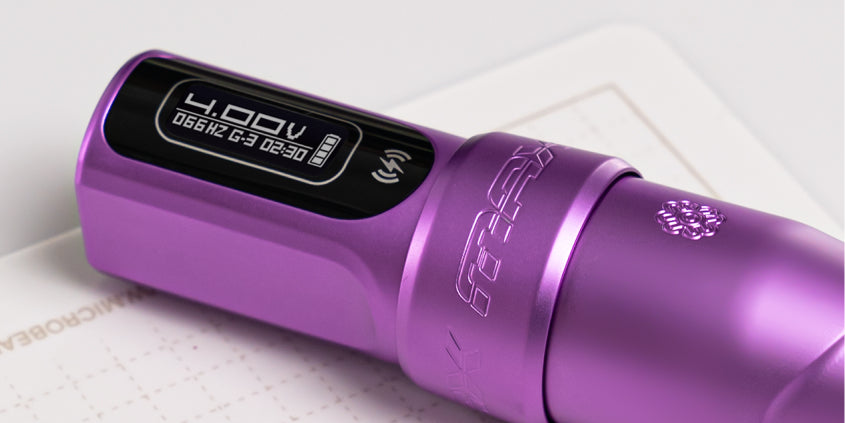
Voltage plays a major role in how your PMU machine performs, but higher or lower isn’t automatically better. Your voltage affects how quickly the needle cycles, and that speed has to work with your hand speed, cartridge, technique, and treatment area.
Finding the right setting means understanding how those variables work together. In this guide, we’ll break down what voltage changes, how different settings can affect your work, and how to find a comfortable range for your machine and technique.
What Voltage Actually Controls
Voltage controls how much electrical power your PMU machine receives. On most rotary machines, increasing the voltage generally makes the motor run faster, increasing the rate at which the needle cycles. Lowering it generally slows the machine down. But voltage and machine speed aren’t exactly the same thing. For example, two machines running at the same voltage can produce totally different needle speeds depending on their motors, stroke lengths, mechanics, and other settings.
Some machines make that distinction easier to see by displaying Hertz (Hz) instead. Hertz tells you the actual cycle frequency—how many complete needle cycles the machine makes per second. Think of voltage as the input and Hertz as one measure of the resulting output.
It also helps to separate a few settings that artists sometimes lump together:
- Voltage: Controls the electrical input to the motor and generally influences how fast and forcefully the machine runs.
- Hertz: Measures the machine’s cycle frequency, or how many complete needle cycles occur each second.
- Stroke length: Measures how far the needle mechanism travels during each cycle.
- Needle protrusion: Describes how far the needle extends beyond the cartridge tip.
- Working depth: Describes how far the needle actually enters the skin as you work. Protrusion, pressure, angle, stretch, machine speed, stroke, needle configuration, and the skin itself can all influence it.
So, turning up your voltage doesn’t simply make the needle “go deeper.” It changes how the machine runs, which then changes how it interacts with your hand speed, cartridge, technique, and the skin. That relationship—not the voltage number by itself—is what matters during a procedure.

Higher Voltage vs. Lower Voltage: What Actually Changes
Higher voltage generally makes the needle cycle faster. Lower voltage generally makes it cycle slower. But the voltage number alone doesn’t tell you exactly how fast the needle is moving, since different machines can respond differently to the same voltage.
Higher also doesn’t automatically mean more powerful, and lower doesn’t automatically mean gentler. The right setting depends on your machine, cartridge, technique, hand speed, and the skin in front of you.
What matters most is how those variables work together. As machine speed increases, your hand speed needs to work with that cycle rate to control how much pigment you deposit in an area. Move too slowly for your machine speed and you can repeatedly work the same section of skin; move too quickly and you may not build the saturation you want. Rather than treating a voltage number as a shortcut to a particular result, use it as one part of a balanced machine-and-hand-speed setup.
Voltage and Hand Speed Work Together
Voltage and hand speed work as a pair. Voltage influences how quickly your machine cycles, while hand speed determines how quickly you move those cycles across the skin. Together, they affect how closely needle contacts land and how efficiently you build pigment.
Move slowly while running a faster machine, and you concentrate more needle contacts in a smaller area. That can build saturation quickly, but linger too long and you may repeatedly work the same skin, increasing redness, swelling, and unnecessary trauma.
Move quickly with a slower machine, and you spread fewer needle contacts across the same area. Depending on the technique, that can create lighter, more open coverage—or leave strokes broken and saturation patchy when you actually want a denser deposit.
That’s why there’s no magic voltage that automatically delivers perfect pixels, crisp strokes, or solid saturation. The goal is to find a machine speed that complements your natural hand speed and gives your technique the coverage you want without unnecessarily working the skin. And remember: cartridge, stroke, pressure, stretch, and skin type are still part of the equation.
Want to dig deeper into that relationship? Our PMU hand speed guideOpens a new window breaks down how machine speed and hand speed work together across different techniques.
Why There's No Best Voltage for PMU
Ask five artists for their ideal voltage and expect five different answers. That's not because four of them are wrong. Voltage doesn't translate the same way across PMU machines.
Motor design, stroke range, and cartridge resistance all shape how a given voltage performs. Consequently, a setting that feels smooth on one machine can feel abrupt on another at that same number.
Your hand adds another layer. Two artists on the same machine with the same cartridge can still need different voltage settings, simply because their pressure, stretch, and hand speed differ.
A number another artist swears by is a starting point that you can experiment with, not necessarily the correct voltage for you and your style.
How Voltage Shifts Across PMU Techniques
Different PMU techniques call for different relationships between machine speed, hand speed, cartridge, and movement. There’s no universal voltage for any one technique, but these broad ranges can give you a starting point for understanding how artists may approach each one:
- Nano brows — roughly 3–6V: Hairstrokes typically benefit from a controlled machine speed that lets you create fine, consistent lines without skipping or repeatedly working the same path.
- Powder brows — roughly 5–8V: Shading requires a rhythm that works with your pendulum, whip, or circular movement to build soft pixelation and gradual density rather than harsh, solid patches.
- Lip blush — roughly 5–8V: Lip work often uses a steady machine speed across overlapping passes to build even coverage while avoiding unnecessary repeat work on tissue that may swell as the procedure progresses.
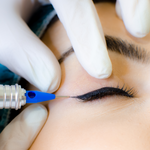
- Eyeliner — roughly 4–6V: Thin, mobile eyelid skin calls for control. Machine speed should complement short, deliberate movements rather than encourage you to compensate with extra pressure or repeated passes.
- SMP — roughly 4–7V: Scalp micropigmentation relies on controlled, repeatable impressions. Your machine speed needs to work with your hand rhythm so you can maintain consistent dot size and spacing across the treatment area.
Treat these ranges as general reference points, not recommended settings. Voltage behaves differently from one machine to another, and even two machines displaying the same voltage can produce different cycle rates and working characteristics.
Always work within your machine manufacturer’s recommended operating range and use your training and tissue response to guide adjustments.

Voltage and Needle Configuration
Your cartridge changes how a given voltage feels the moment you start working. Needle count, diameter, and configuration all affect the resistance your machine works against.
A single needle concentrates force into one small point of contact. A larger grouping spreads that same voltage across more surface area, so the machine can feel entirely different even though the voltage hasn't moved.
Membrane tension plays a role too. A tighter membrane resists needle movement more than a looser one, which changes how the cycle feels at the same setting.
Adjusting voltage without accounting for your cartridge only tells half the story. Needle configuration still has the final say in how that voltage plays out on the skin. Our guide to machine and needle choiceOpens a new window covers how the two work in tandem.
Signs Your Setup Needs Adjustment
Watch for these signs that your voltage, hand speed, and cartridge aren't working as a team:
- Inconsistent saturation across the same pass
- Extra passes needed to reach the color you want
- Pixelation that looks scattered instead of even
- Skin reacting more aggressively than usual, with excess redness or swelling
Voltage is one variable in that mix, not the only one. Check your hand speed and cartridge before you touch your voltage. Adjusting the wrong variable can mask the real problem instead of solving it.
Finding Your Working Range
Start inside the range your machine's manufacturer recommends. That range already accounts for your motor and stroke design, which makes it a far more reliable starting point than a number borrowed from someone else's setup.
Practice on practice skin before you change anything on a client. Adjust one variable at a time: voltage first, note the result, then hand speed or cartridge next.
Once you land on a range that delivers consistent results, treat it as your baseline. You can always build from there as you pick up new techniques or new cartridges.
Why Your Machine Matters
A voltage number from one machine won't carry over to another. Motor design, stroke range, and cartridge resistance all shape how a machine performs at any given setting.
That's why comparing machines by voltage number alone tells you very little. Two machines set to the same number can feel completely different in your hand.
Our PMU machine buyer's guideOpens a new window covers what to look at beyond voltage, including stroke, weight, and cartridge compatibility, so you can compare machines on the specs that actually shape your technique.
Build Your Working Range With the Right Machine
Overall, your ideal voltage isn't something you copy. It's something you choose, adjust, and fine-tune through experience. Explore our full lineup of PMU machinesOpens a new window and find a motor and stroke range built to support the technique you've spent your career refining.